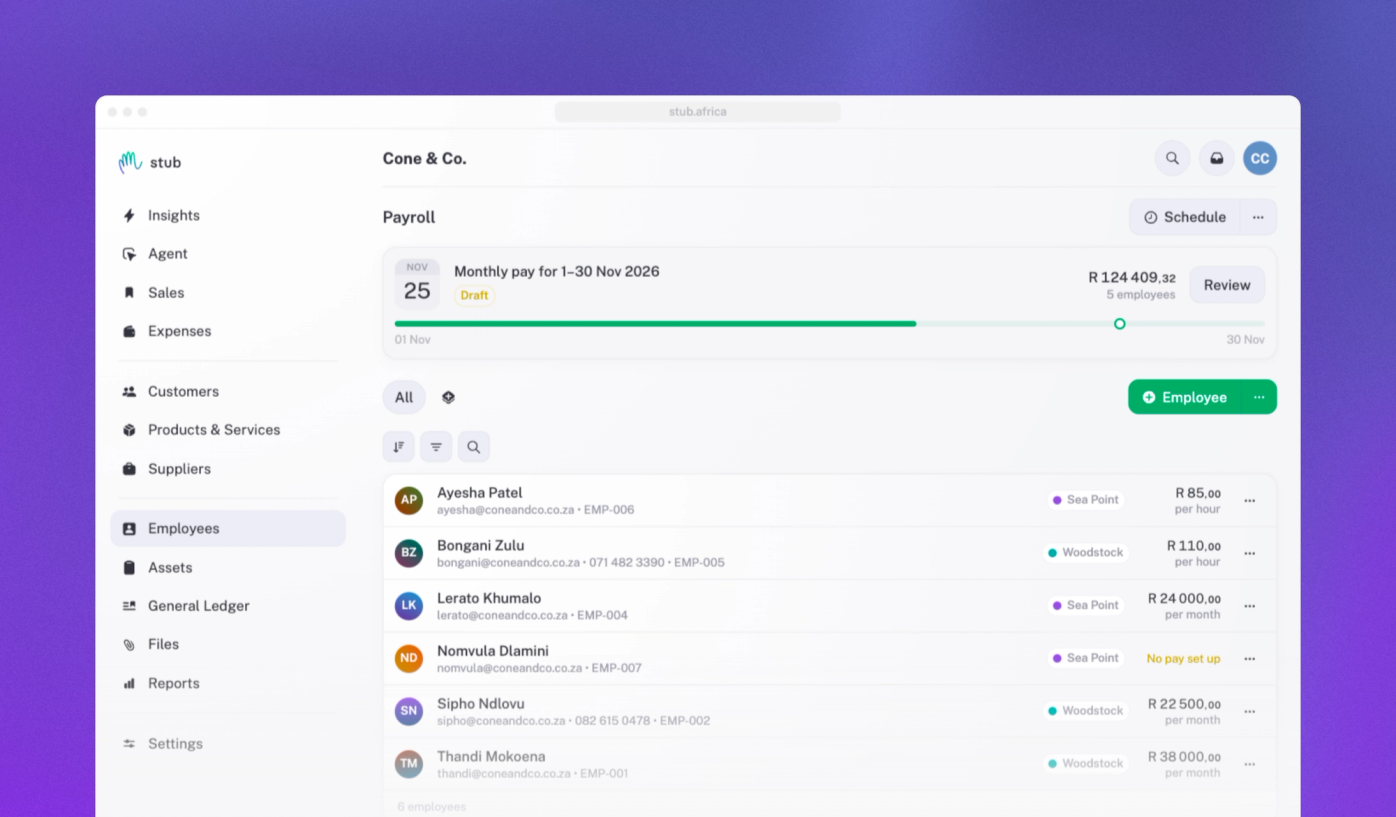
Payday on autopilot
Payroll now lives in stub, right next to your invoices, bank and books. Set it up and pay day mostly runs itself.
- Easy set up: tax numbers, leave, extras and your pay schedule.
- You can pay monthly, twice a month, fortnightly or weekly, by the year, month, week, day or hour.
- Payslips are drafted for every run and then automatically complete on pay day.
- PAYE, UIF, SDL, ETI are worked out for you.
- Your team gets their payslips by email, as a PDF.
- EMP201, EMP501 and IRP5 are prepared in Reports, marked Due, Overdue or Filed.
- Every run posts to your books. No manual journals.
- Leave types and balances, set up for how you run your business, kept per person.
You still pay your team from your bank. stub shows exactly what each person is owed.
Go on, give pay day the day off. 😎
Meet the stub agent
A new Agent page, and a launcher in the bottom-right corner of every page. It greets you, suggests where to start, takes the files you drop in and links you straight to the right page in stub.
The agent does more of the work
It can now email a report to your accountant, save reports to Files as a PDF or CSV, apply credit notes to invoices, change due dates in bulk and save Insights dashboards. Every table it gives you downloads as CSV or Excel, or copies in one click.
Improvements
Bank: We improved automatic categorisation, so bank fees, decline and over-limit charges, prepaid electricity fees and FNB round-ups land in the right category.
Bank feeds: every feed shows when it last synced.
Activity log: Settings › Activity reads as who did what, when, and names the item added, edited or removed.
Credit limits: opening balances now count, and recurring invoices warn instead of blocking.
Imports: large client and supplier lists import in chunks and say what was skipped.
Bank: revalue your foreign bank accounts, invoices and bills at period end, so FX gains and losses land without manual journals.
Fixes
Invoices & quotes: a refused save now says why, and a refused currency change puts the old currency back.
Expenses: foreign-currency expenses post at the exchange rate. Deleting one no longer brings back its bank line.
Debit notes: if they are made without accounts, they post to payables.
Bank lines: excluding one removes its linked income or expense, and include brings it back. Split references no longer import twice.
Credit notes: a linked credit note ages from its invoice's due date.
Locked periods: stay locked. No linking a bank account into one, and late rate misses no longer block a lock.
Bank feeds: freshness reads the newest line, so feeds no longer look stale when they should not.
Payments: reversals that arrive before their payment are kept and booked later.
Security: fixed a bug where setting up an authenticator asks for your password again instead of failing, and passkey-only accounts are guided to set one.
Payment links: now product payment links stay hidden until a business has a handle.