

The creative economy
The creative economy in South Africa is estimated to account for 6% of employment. That’s a lot. 3,5 million people if you’re trying to do the sum in your head. 3,5 million people whose business is them and what they create and give to the world (to the stats policeman, we used the word estimated 😉). We know getting correct numbers in this space is hard to go by but if it’s anywhere close to this, there are very exciting times ahead and how lucky are we to be in a country where there is so much magic.
We’re passionate about an industry like this because it’s kind of one of the reasons why stub started. In the beginning, we realised that existing accounting tools were complicated and expensive and they didn’t serve the entrepreneurs who create and make things in the world. And that was it, we started building it super simply so that creators could focus on what they love, and we would do the numbers, admin and accounting stuff.
Hello Artists’
Collaborating with artists and artist communities, not to sound too cliche, felt like a match made in heaven. We met @Sara Hallat through a mutual friend and hit it off from the get go. It was incredible to understand a bit more about her world and the different things she does for, and with, the Joburg art industry. Not to brag but Sarah is the CEO of the META foundation, a co-founder of Contra JHB which is the city's biggest open air art festival and she runs the largest art studio in the Joburg CBD, August House. August House was established as an artist studio space in 2006 and currently has about 44 artists in studios. The META foundation is a dynamic visual arts organisation that works with the artists of August House. The META foundation is interested in providing artists with as much as possible to allow them to survive and thrive as artists.
So what’s the point of collaborating with artists and these communities? It's about learning, empowerment and solving specific needs and nuances for us. Each creative niche is so unique and diverse and we love to take a deep dive into the different worlds and try to understand each of them a little bit better than we did before. Entrepreneurship is extremely layered and every human’s business situation is different. Where we can start understanding similarities and the differences is through what you sell or do, and in what industry you operate within and contribute to.
Understanding the business side of the art world is crucial for artists as it enables them to navigate the complexities of the industry with greater confidence and efficiency. Artists who are knowledgeable about business practices can better promote their work, secure fair deals, and establish a sustainable career. This knowledge allows them to engage effectively with galleries, collectors, and other industry stakeholders, ensuring that their work reaches the right audience and receives appropriate recognition. Moreover, understanding the business side of art can help artists avoid common pitfalls and exploit opportunities that might otherwise be missed.
The Art of Accounting
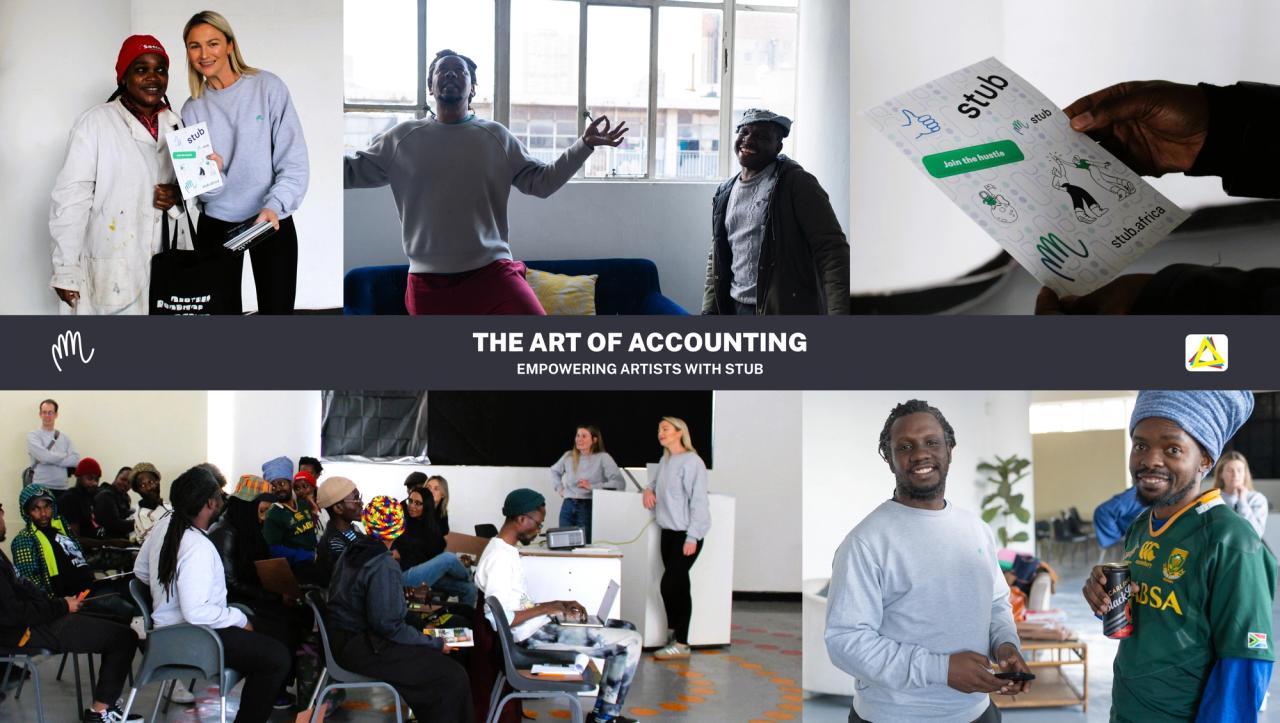
Let’s talk about what we actually did together, us, Sarah, and the artists of August House. We ventured into the JHB CBD on the afternoon of the 16th of July. We arrived in Doornfontein and wow, there was energy everywhere, it was infectious and infinite. You know those kinds of places that just epitomise the South African heartbeat? It was one of those.
We ran a 3-hour workshop with the August House artists where we practically worked through how to set up their business on stub. Having a handle on finances is essential for artists to maintain a stable and sustainable career. Financial literacy helps artists manage their income, expenses, and investments, ensuring they can continue to create art without the constant stress of financial instability. It allows them to budget effectively for materials, studio space, marketing, and other essential aspects of their practice. Additionally, understanding financial principles can help artists make informed decisions about pricing their work, negotiating contracts, and planning for long-term financial health, including retirement and savings.
Moreover, artists who understand and manage their finances are better equipped to seize opportunities for growth and innovation. With a solid financial foundation, they can invest in new projects, explore different mediums, and take creative risks that can advance their careers. Financial stability also provides the freedom to experiment and evolve artistically without being constrained by immediate economic pressures. In this way, financial acumen not only supports the practical aspects of an artist’s career but also fosters an environment where creativity and artistic exploration can thrive.
Inspired by our new friends at August House
We finished off the workshop with an hour of getting to know each other a bit better, over a zamalek or two. These are always some of the best parts about these days, where you really get to hang out and engage human to human. What we really found fascinating through this, is how many of these creative entrepreneurs do more than one thing. An artist is not just an artist, but a photographer and sculptor too. They may even dabble in the digital asset space, turning their craft into sellable digital NFTs. Does this make them a crypto trader? Some would say yes.
Hardworking and hustling are common adjectives to describe the working culture of South Africans, but witnessing this firsthand has been the best part. We’re all out here just trying to make a life while fulfilling our talents and passions along the way.
To many more days like these and new friends, like August House!