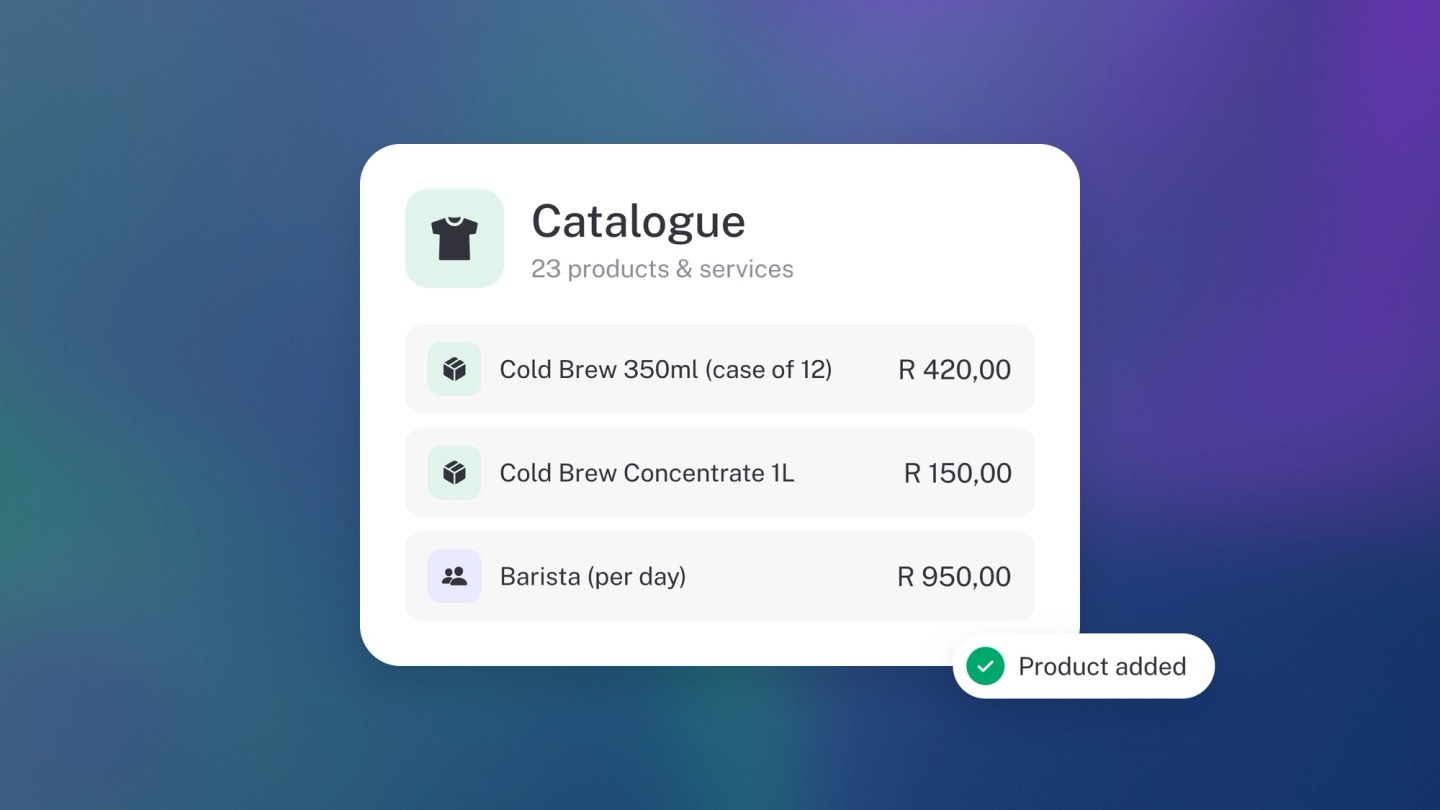
In stub, everything you sell is an item — a product off the shelf or a service you charge for, saved with its name, price and tax. Your items live under Products & Services in the sidebar, and together they make up your catalogue.
If you retype the same three services on every invoice, or dig through old invoices to remember what you charged last time, this is the fix. Save what you sell once, and every invoice after that is one click — the right name, the right price, the right tax, without retyping a thing. That's the stub way: set it up once, keep it simple.
Add an item
An item needs just a name and a price. Everything else can wait.
Click Products & Services in the sidebar, then Item (or press N). Give it a Name, a Description and the Price you sell it for, then Save — that's a working item.
Everything else is optional — click the buttons at the bottom of the window to add the fields you need.
Add the optional fields
- Cost price — what the item costs you. stub uses it to work out what you make on each sale, and warns you if it's higher than your price.
- Units — how you sell it: hours, kilograms, each.
- Image — a picture for your catalogue and your payment links.
- Notes — anything you want to remember about the item.
- Variant — a version of an item, such as a size or colour. See Add variants to an item below.
Add variants to an item
One t-shirt, three sizes, one entry in your catalogue. Variants let a single item carry several versions — sizes, colours, packages — so your list stays tidy, your invoices stay precise, and you never duplicate an item just to change one detail.
On a new item
- Click Products & Services in the sidebar, then Item (or press N).
- Fill in the Name, Description and Price. This is the umbrella item, and its price is what the variants inherit.
- Click Variant in the row of buttons at the bottom of the window.
- Enter the variant's Name (for example Small) and its Price.
- Click Variant again for the next one.
- Click Save when they're all in.
On an item you already have
Open the item from Products & Services, click the ··· menu on the item panel, and choose Variant. Fill in the details and click Save. On the item's own page, the Variants list has a Variant button that does the same.
What goes on each variant
- Name — what appears on invoices and quotes. Keep the naming style consistent.
- Price — pre-filled from the parent item. Change it per variant.
- Sales Tax — set a rate on the variant if it differs from the parent. See Set the tax on an item.
- Optional extras — description, cost price, SKU, barcode, notes and an image. Open the variant with ··· → Edit on its row to add them.
What happens to stock you already have
Worth knowing before you add your first variant, so nothing surprises you. All existing stock moves onto the first variant you create — stub warns you on screen: "[Product] has 25 stock that will be moved to this variant." Nothing is lost or double-counted, and every variant after that starts at zero. Once they're all in, split the stock across them with stock adjustments — see Track inventory & stock.
Selling a variant
Add the item to an invoice or quote and stub asks which variant you're selling. Your customer sees the full name — for example Classic Crew Neck T-Shirt • Medium — and the price and stock update automatically.
Tip: Give each variant its own SKU if you track stock on a shelf — stock takes and reorders get much easier.
Set the tax on an item
On Growing Business with Sales Tax turned on, a Sales Tax section appears under the price.
- Add the rate that applies to this item.
- Choose whether the price you entered already includes the tax, or the tax gets added on top.
Track stock on an item
Turn on Track stock — it comes with Steady Startup — and stub counts this item in and out as you buy and sell: no tally on the back of an envelope. See Track inventory & stock.
Use an item on an invoice
This is where the saved item pays off. Open any invoice or quote, click Add item, and pick it from the list. Your price, units and tax come with it — and you can change any of them on the line without changing the saved item.
Edit or delete an item
Open the item from Products & Services to change any field. To remove it, open it and click ··· → Delete.
Note: stub does not have separate "physical product" and "service" types, and there is no SKU field. Use Units to say how you sell something, and Track stock for anything you hold.