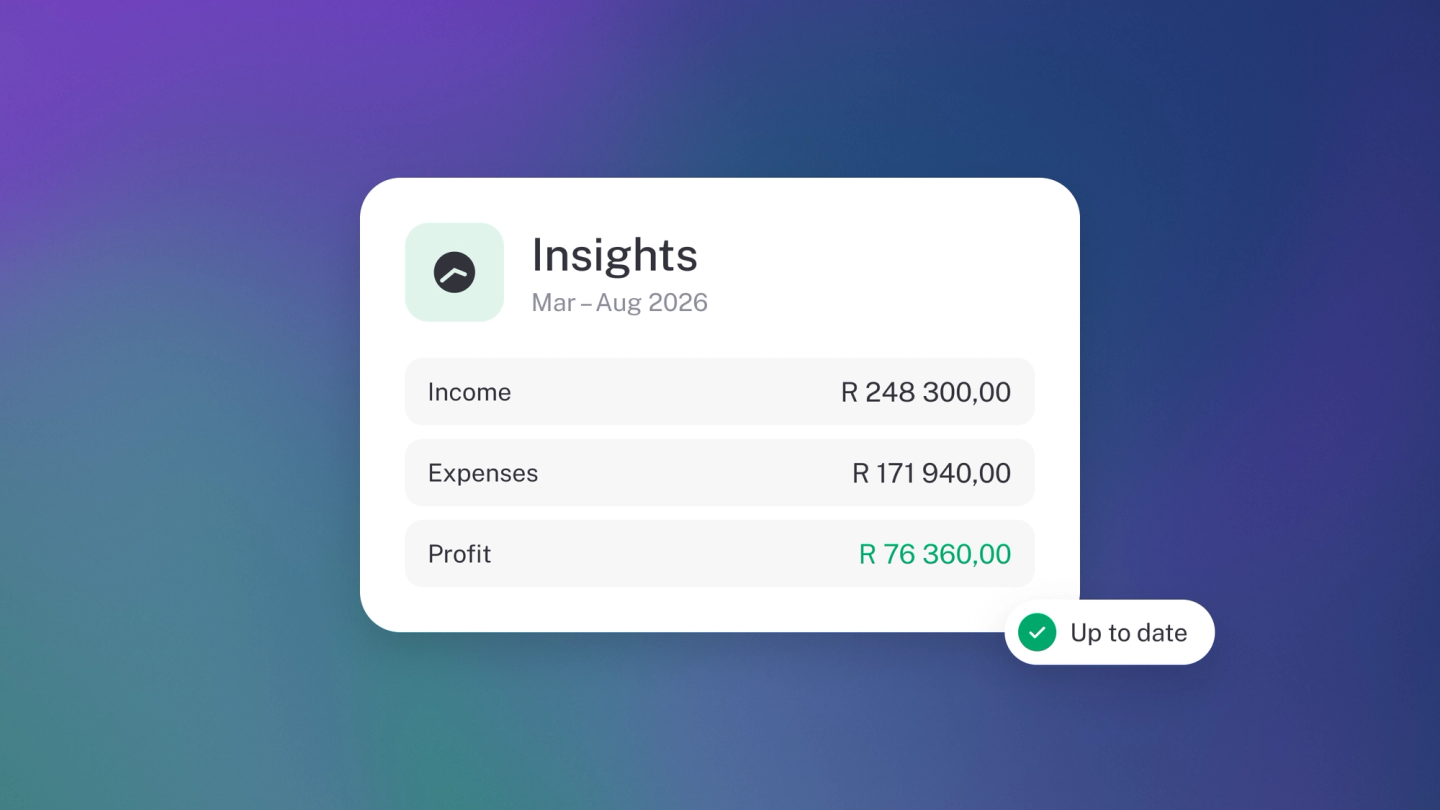
Most owners find out how the month went weeks after it ended, usually from an accountant. The Insights dashboard is the alternative: one screen that answers "how is my business doing right now?" without running a single report — profit for the period, money in against money out, who still owes you, what's in each bank account, and where you stand on tax.
It's also the reward for keeping the books current. Every number on it is built from what you've recorded, so the dashboard gets sharper the more of your day-to-day actually lands in stub — and the emptier it looks, the more it's telling you about your record-keeping rather than your business.
What to know before you trust it
- Every tile opens the report behind it. Click a tile and stub opens the full report — Profit & Loss, Sales, Expenses, Cash Flow, Account Recon, the overdue or upcoming list, or the tax summary. That makes the dashboard the fastest way in the whole product to get from an odd figure to the mis-dated, duplicated or mis-categorised entry causing it.
- A figure that looks wrong is nearly always uncategorised transactions. Nothing uncategorised reaches your income and expense breakdowns. Clear the backlog and the dashboard usually corrects itself — see When report numbers look wrong.
- It's a highlight reel, not a formal report. Nobody outside the business will accept it. Lenders, investors and accountants want a Profit & Loss and a Balance Sheet, and the tax authority wants the VAT report.
- Profit and Cashflow answer different questions. Profit counts invoices when you send them; Cashflow counts money that actually moved. Seeing a healthy profit next to thin cash isn't a bug — it means money is sitting in unpaid invoices. Money moved between your own accounts doesn't count as cash in or out.
- Almost every tile follows the period at the top. The dashboard shows the month (or range) picked at the top, so before you worry about a strange figure, check which period you're looking at. The exceptions: Invoices and Bills always show what's overdue or coming up as of today, and Returns keeps any older return that's past its deadline pinned at the top whatever the period.
Where to find it
Click Insights in the sidebar — it's also the first screen stub opens when you log in. The arrows at the top step back or forward a month, and clicking the month itself opens longer ranges. Step through two or three months and you're reading a trend rather than a snapshot.
What's on the dashboard
The dashboard is made of tiles. The layout you start with is called Overview, and it depends on your plan:
- Every plan — Profit, Income and Expenses across the top; your overdue Invoices listed beside Cashflow; and a tile for each bank account, plus Cash.
- Steady Startup — all of that, plus your overdue Bills.
- Growing Business and Established Entrepreneur — Steady Startup's layout plus a tax row: Sales tax due (it reads VAT due or GST due where that's what you file), Income tax and Returns. Each tax tile only appears once that tax is set up.
You can add any tile on any plan. There are eleven to choose from:
- Profit, Income and Expenses — the period's figure, with the trend. Income and Expenses can also chart as a pie split by category, customer, product or supplier.
- Cashflow — money in less money out. Configure it to show just money in or just money out.
- Account — any figure from your books: a single account, a group of accounts, your bank and cash, or a formula.
- Bank account — one account's balance, in its own currency, and how many transactions on it are still uncategorised. Click it to open Account Recon for that account.
- Invoices and Bills — what's overdue or what's coming up. A taller tile lists the documents themselves.
- Sales tax due and Income tax — where you stand for the period.
- Returns — every sales tax, income tax and payroll return due in the period, badged Filed, Due or Overdue. Click a row to open the return.
Every figure compares itself with the period before, and you can hover over a chart to read the value for a single day or week.
Open the report behind a tile
Click a tile and stub opens the report that makes it up — fix anything mis-dated, mis-categorised or entered twice while you're there. On an Account tile, Opens in its settings decides which report that is.
Make it your own
Everything on the dashboard can change. The ··· menu next to the view buttons at the top is where you start:
- Tile — add a tile. Pick the type, set it up and click Save; it lands on the dashboard straight away.
- Edit Overview (or Edit and the name of your view) — drag tiles to move them and drag a tile's corner to resize it. Click Save to keep the new layout, or Cancel to put it back.
- Reset — put Overview back to the layout stub started you with. stub asks you to confirm first.
How tall a tile is decides how much it shows, so you choose between a compact dashboard and a detailed one just by resizing. One row is just the figure. Drag the corner to make it two rows or more and the chart appears — or, on Invoices and Bills, the list of documents. A narrow figure tile widens a little when it grows, to make room for its chart.
Each tile has its own ··· menu too. Configure changes what it shows — its Name, its chart (pick Line, Bars or, where offered, Pie), then the fields that follow, like Split by for a pie, Group by day or week, Cumulative and Colour. An Account tile adds the Figure and what it Opens, and Cashflow adds Show. On a one-row tile, Configure reminds you to make the tile taller to see the chart. Remove takes the tile off after an "Are you sure?". Both save as soon as you confirm.
Save a view
Want a dashboard for each job — one for cash, one for tax time? Click the Save view icon at the end of the view buttons, name it and it appears next to Overview, ready for its own tiles. A view's ··· menu lets you Rename or Remove it; removing a view removes its tiles with it.
Saved views belong to the business, so everyone on your team sees the same set. Overview is different: changes you make to it stay on the device you made them on. See Custom views and filters.
Which report do I actually need?
The dashboard is the summary. Each tile opens its own report, and Reports in the sidebar lists every one of them.
- Checking profitability → Profit & Loss
- Checking whether you can afford something → Cash Flow
- Prepping for tax → VAT / Sales Tax plus Profit & Loss
- Working out what's driving sales → Sales report
- Cutting costs → Expenses report
- Snapshot of what the business is worth → Balance Sheet
- Checking the books balance → Trial Balance
Tip: Open Insights for two minutes at the start of each week. The habit is worth more than any single number on it — you catch the mis-categorised entry, the overdue invoice and the cost that crept up while all three are still small.