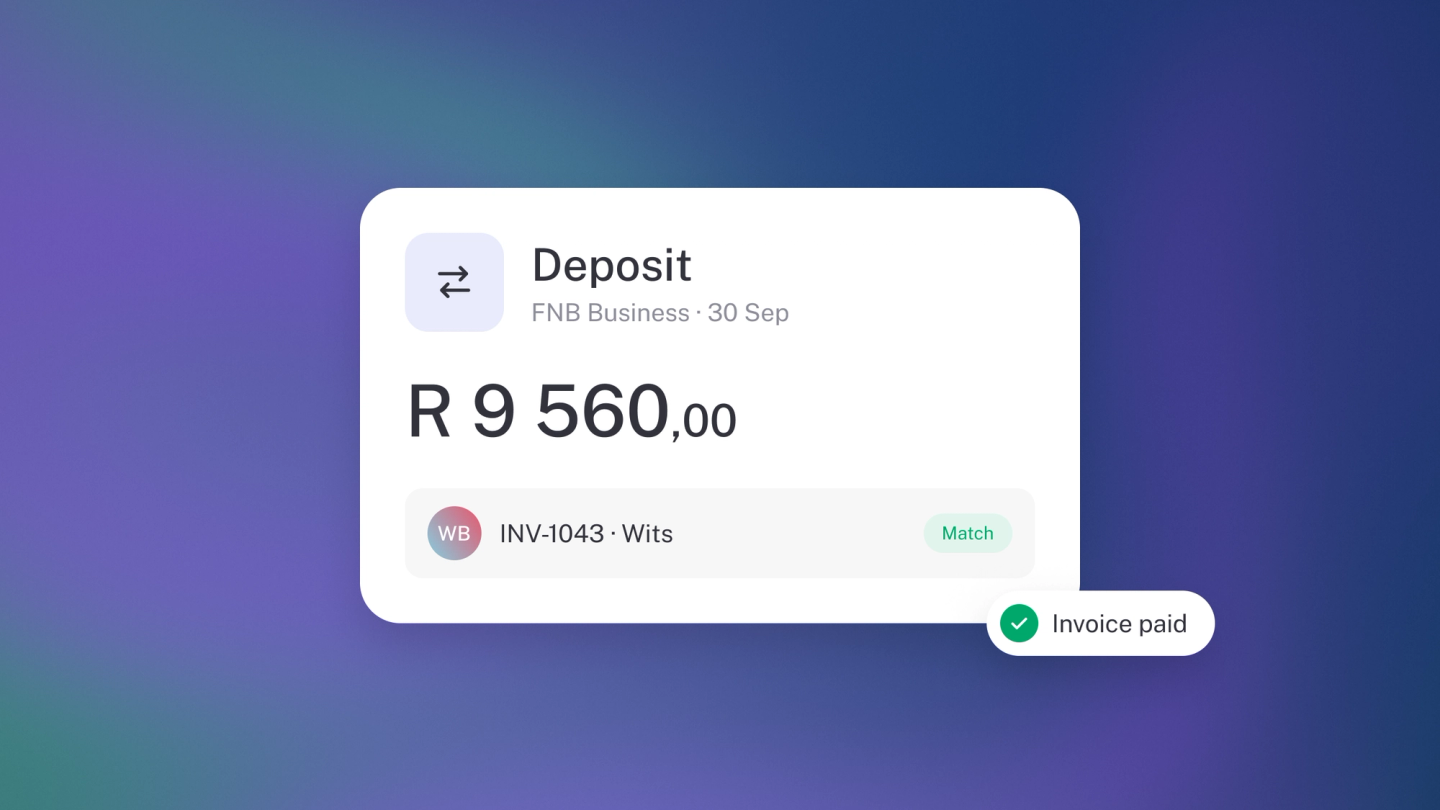
You recorded the income the moment you raised the invoice. So when the money lands in your bank, the job isn't to record income again — it's to tie the deposit to the invoice it settles. Get this right and your income is counted once, your profit stays honest, and your chase list always shows who still owes you.
Record the payment on the invoice
- Click Sales in the sidebar and open the invoice.
- On the Payment panel on the right, click Payment.
- Enter the amount and the date, and pick the bank account the money landed in.
- Save.
The invoice moves to Partially paid or Paid, and the outstanding figure on the panel drops.
Clear the deposit from your bank feed
The payment you just recorded and the deposit in your bank feed are the same money arriving twice. So when you work through the account in Account Recon — click its tile on Insights — or in Sales filtered by Uncategorised, don't give the deposit an income category — that's the double-count.
When stub spots the pair, the deposit's ··· menu offers Remove duplicate — use it to bin the copy and keep the payment that's tied to the invoice.
Handle one payment covering several invoices
- Open each invoice in turn.
- Record a Payment against each for its own amount.
- Check that the amounts add up to the deposit that hit your bank.
If you would rather split the deposit itself, use ··· → Split on the transaction. See Split transactions across categories.
Handle a part payment
Record what actually arrived. The invoice moves to Partially paid and keeps showing the balance still outstanding, so it stays on your chase list.
Check nothing is double-counted
Open the customer under Customers and check Total outstanding against what you believe they owe — click Statement for the full picture.
Note: If you categorise a customer deposit straight to an income account instead of recording it against the invoice, you count the income twice — once when you raised the invoice, once when the money arrived. Always tie the deposit to the invoice.